Mexican Grand Prix: The VSC Controversy
- shiftinggearsuk
- Oct 31, 2025
- 3 min read

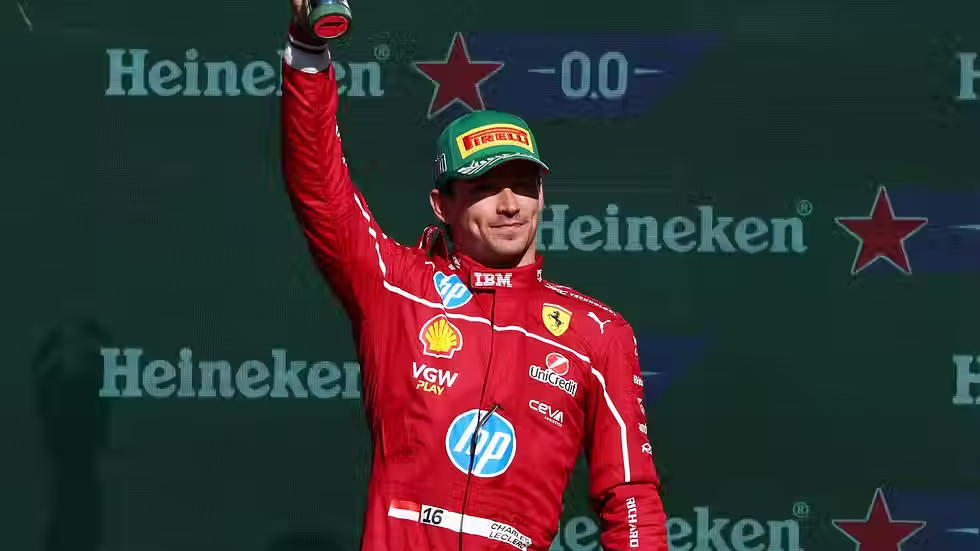
An extremely late Virtual Safety Car at the Mexican Grand Prix has sparked controversy, after dictating the end of the race. But why was it so controversial?
Lando Norris dominated this weekend’s Grand Prix, going from Pole position to victory. However, following behind him were extremely tight and close battles the entire way through the race.
On lap 70/71 of the race, yellow flags were waved at the final corner of the circuit. Following an already difficult race with several penalties, Carlos Sainz had spun his Williams around and was facing the wrong way.
With only a few moments left of racing, the race marshals and FIA had to think quickly on how to handle the hazard.
With a battle for second place closing in by the millisecond, every moment of racing was vital. Leclerc was being chased by the reigning World Champion, Max Verstappen, with a gap of only 0.3 seconds. Though the race was almost over, this fight had only just begun.
Simultaneously, Oscar Piastri was edging closer to Haas's Oliver Bearman, a move that would prove crucial in maintaining his lead of the Driver’s World Championship.
As Verstappen began closing in, the Virtual Safety Car was called, neutralising the race completely. With a reduced speed and no overtaking allowed these opportunities for overtakes were barred.
Whilst Carlos Sainz had managed to pull his car to a nearby marshal's post and exit between the barrier, the Virtual Safety Car remained. This sparked confusion within F1 fans, commentators, and teams.
The hazard-Carlos Sainz’s stranded Williams- was swiftly removed from the track, leaving there with no current dangers in that sector. ‘So why was the VSC deployed?’ is the question that was asked by millions of viewers.
SkySports’ David Croft (Crofty) said during the race “I just don’t understand from what we can see of the onboard, why we need a Virtual Safety Car”
Many felt that the call for a Virtual Safety Car was unnecessary and could have been dealt with under the yellow flags that were being waved initially, due to the speedy removal of Sainz’s car from the track. Yet, this was not the case.
The deployment of the VSC prevented the chance of Max Verstappen and Oscar Piastri continuing their chances for overtakes and seemingly determined the race results.
On lap 71, the VSC ended and racing resumed. Unfortunately for Verstappen and Piastri, this was too late for them to complete their moves, finishing in 3rd and 5th respectively.
Though the VSC impacted the races of Verstappen and Piastri, it potentially cemented Leclerc’s 2nd place and Oliver Bearman’s 4th. Speaking to SkySports, Leclerc said that he thought the VSC “saved me at the end.”
Oliver Bearman equalised Haas’ best finish in Formula One and for himself, a huge achievement for the 20-year-old. He described it as “definitely a cray race.”, showing the adrenaline and excitement of the race.
Yet, the confusion does not end there. Fans have recognised the inconsistency in Virtual Safety Car deployments.
Earlier in the race, Liam Lawson narrowly missed hitting two marshals that had been sent on track to retrieve debris.
Outrage about this has swarmed the internet, wondering why the FIA did not intervene at this point of the race, when there was an active hazard on track.
Lawson expressed his fear and anger over the radio with “I could have f**cking killed them!”
The inconsistency of FIA penalties, safety car deployments and racing decisions has been a perpetual issue.
The underground rumbling of anger from drivers, teams and fans has recently become more vocal, as results have been decided and altered due to the FIA’s sometimes unreasonable decisions.
Again, this incident has proved to be a vital turning point in the Championship and has caused confusion for many F1 viewers.
Written by Jessica Eccles


Comments